'/%3E%3Cpath%20fill='%23b2b2b2'%20d='M241%20382q0%2016%2017%2026%2017%2011%2042%2011t42-11q16-11%2017-26V269H241'/%3E%3Cpath%20fill='%239f7e00'%20d='M241%20379q0%2014%208%2023%209%209%2021%209%2014%200%2021-9%209-9%209-23V269h-59'/%3E%3Cpath%20d='M241%20339v-70h59v110q0%2014-9%2023l-6%205v-68h-15v72q-8%200-14-4v-68zm59%2040c0%2022%2015%2032%2029%2032%2021%200%2030-18%2030-32v-40h-59'/%3E%3Cpath%20fill='%239f7e00'%20d='M266%20277v5h2v12h-3v-5h2v-5h-9v5h2v5h-4v9h3v18h-5v10h34v-10h-5v-18h3v-9h-4v-5h2v-5h-9v5h2v5h-3v-12h2v-5zm42%20101q0%2010%206%2017%206%206%2015%207%2010-1%2016-7%206-7%206-17v-29h-43'/%3E%3Ccircle%20fill='%230044ad'%20cx='329.5'%20cy='372'%20r='6'/%3E%3Cellipse%20fill='%230044ad'%20cx='300'%20cy='340'%20rx='16'%20ry='21'/%3E%3C/svg%3E)
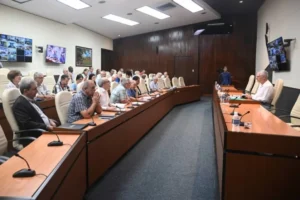 Cuban President Miguel Díaz-Canel led a meeting on Tuesday, April 14, with experts and scientists to evaluate the progress of the energy transition on the island. The meeting highlighted the results of the joint work between the Ministry of Energy and Mines and the National Group of Universities for Renewable Energy Sources and Energy Efficiency (GNUFRE), focused on leveraging available resources and technologies to generate efficient solutions.
The meeting featured presentations of bioenergy projects focused on the production of biogas and biomethane from pig, livestock, and industrial waste. Among the initiatives highlighted were the Martí project, a pioneer in the use of biomethane for transportation, and the Managuaco project, which proposes a domestic fuel network.
The proposals aim to transform wastewater treatment systems into active energy sources through the use of biodigesters. The potential of forest biomass and the development of solid biofuels for use in industrial ovens, cooking, and steam generation were also discussed.
A key point of the meeting was the proposal for a new technological model for the sugar industry. This proposal seeks to transform the sector into a flexible and reliable source of electricity generation for the country.
Under this concept, the industry would not only be self-sufficient through the use of alcohol and biomethane, but would also provide fuel for transportation and byproducts for animal feed to increase meat production.
The exchange was moderated by Deputy Prime Minister Eduardo Martínez, with the participation of Deputy Prime Minister Inés María Chapman and the Ministers of Energy and Mines, Vicente La O Levy; Higher Education, Walter Baluja García; and Science, Technology and Environment, Armando Rodríguez Batista. Directors from various universities across the country also participated via videoconference to coordinate joint work between academia and the state sector.
The GNUFRE (National Network of Energy and Sustainable Development Centers) is a strategic pillar in the transformation of the country’s energy matrix. Established in 2019 with seven institutions — Sancti Spíritus, Villa Clara, Havana, the José Antonio Echeverría Technological University of Havana (CUJAE), Oriente, Cienfuegos, and Matanzas — as a response to the development policy approved in 2014, this group has expanded its reach to all higher education institutions with energy development potential.
Currently, this academic network, which extends to all higher education institutions, plays a fundamental technical and legislative role, supporting the consultation process and presentation of the draft Energy Transition Law and its complementary regulations.
Furthermore, it leads innovation projects within the university system to strengthen the presence of science in national programs, ensuring that academic training and research translate into solutions applicable to the national energy reality.
Cuba is making steady progress in installing 2,600 photovoltaic solar systems, designed to protect essential services in the face of the energy crisis.
The Cuban government is implementing a national strategy to address the instability of the electrical system, exacerbated by shortages.