
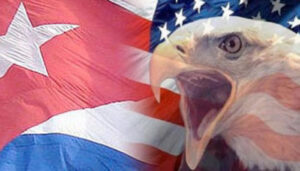
 Habana, Cuba.- The solidarity movement with Cuba in the United States faces a historic urgency today amid the unprecedented escalation of aggression by the current administration of Donald Trump toward the Caribbean nation, sources here affirm.
Prensa Latina confirmed this by asking representatives of organizations here that support the rapprochement between the United States and Cuba, and, first and foremost, the lifting of the long-standing economic, commercial, and financial embargo, for their assessments—as the year draws to a close and 2026 approaches.
For Medea Benjamin, co-founder of the organization CODEPINK, “it is crucial that in 2026 we work with all our strength to counter the strangulation that the Trump administration is inflicting on the Cuban people.”
Now that the U.S. government is openly boasting of reviving the Monroe Doctrine, it is up to us, the people, to say no, the activist and writer emphasized.
“We must reject this brutal imperial interference,” she warned, “and insist that the United States stop interfering in the affairs of our neighbors.”
Cheryl LaBash, co-chair of the National Network on Cuba (NNOC), shares a similar view, noting that the American people do not support the U.S. economic war against the island.
“Over the past year, new organizing centers have joined the movement to stop the war against Cuba and allow Cuba to prosper,” she stated.
According to LaBash, in 2025, trips to Cuba and aid campaigns were the cornerstones of this movement in cities like Denver, Philadelphia, and Jacksonville, Florida.
The city councils of Chicago, one of the largest cities in the United States, and Ypsilanti, Michigan, a small city, also unanimously passed resolutions against the embargo and for Cuba to be removed from the list of state sponsors of terrorism, recalled the co-chair of the NNOC, a coalition of more than 60 groups.
The new “Let Cuba Play” campaign, which advocates for visas so that Cuba can compete in the 2028 Olympic Games in Los Angeles, will help us reach even more people and mobilize their voices, she added.
César Sánchez, also co-chair of the NNOC, referred to the new Suture Campaign for Cuban Doctors and the Cuban People, which will run until the end of February 2026.
“We will continue to foster national and international solidarity with Cuba. We will use all social media platforms to spread our message about Cuba as widely as possible in 2026,” he affirmed.
Meanwhile, Manolo De los Santos, executive director of The People’s Forum, stated that, faced with the intensified aggression from the United States in 2025, with its renewed objectives of regime change and a tightened blockade, the solidarity movement with Cuba in this country faces a historic urgency.
“But in this critical juncture, a powerful opportunity also arises: a new generation of young people, deeply dissatisfied with the Trump administration, is questioning the old dominant narratives,” argued De los Santos, who is also a researcher at the Tricontinental Institute for Social Research.
It is our duty and our hope to reach these young people, dismantle the lies, and show them the reality of an unjust economic war that deserves not only to be denounced but also defeated by the conscience of this people, she concluded.
IN CONTEXT
Currently, U.S. policy toward Cuba has shifted from “maximum pressure to maximum aggression,” stated Johana Tablada, Deputy Director General of the U.S. Directorate at the Cuban Ministry of Foreign Affairs, in an exclusive interview in June during a working visit to Washington, D.C.
Referring to the measures taken by the Trump administration to punish Cuba, the diplomat declared: “We are not surprised.”
“U.S. policy operates on a path of fiction, where things are invented, others are funded to repeat these fabrications, and then Cuba is punished for that fabrication,” she added.
That policy, “could also provoke irresponsible scenarios of confrontation as desired by those who have always hindered and obstructed relations between Cuba and the United States, which could range from a break in diplomatic relations to a situation of such great shortages deliberately caused by the United States.”