
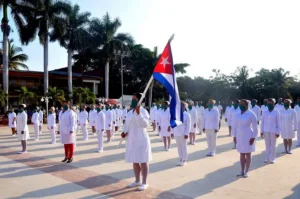
 Cuban Foreign Minister Bruno Rodríguez denounced on Thursday, April 9, that the United States government is pressuring and extorting other countries to eliminate the presence of Cuban medical brigades in an attempt to strangle the Caribbean nation’s economy.
Rodríguez stressed that Washington is using “mendacious pretexts” in its campaign, “as usual.” “It has done so for more than six decades through our trade, investments, bank transfers, and all other types of income for our economy, with more than enough clear and well-known examples,” the official emphasized.
The Minister of Foreign Affairs highlighted the work of the Cuban medical brigades, which carry out solidarity work in hard-to-reach places. Furthermore, the Foreign Minister pointed out, “they help develop health systems with experienced human resources; and their personnel are hired voluntarily, legally, and in accordance with sovereignty, complying with international standards.”
The actions of the administration of US President Donald Trump are part of a prolonged policy of economic harassment against Cuba. “The objectives are to continue isolating the Cuban economy and cutting off legitimate sources of income,” reads Bruno Rodríguez’s post on his social media account.
The Cuban international assistance mission began in 1963 with the first mission to Algeria, driven by the vision of revolutionary leader Fidel Castro. Following the departure of French doctors after Algerian independence, Castro called for volunteers to assist a nation facing healthcare shortages.
“Today we can send only 50 doctors, but in eight or ten years, who knows how many, and we will be helping our brothers,” Castro stated at the time. Since that first mission to Algeria, more than 600,000 Cuban professionals have served in 165 countries.
Initiatives such as the Comprehensive Health Program in 1998, created after Hurricanes Mitch and Georges devastated Central America, the formation of the Henry Reeve Contingent, and Operation Miracle, underpin a history of service in rural areas, low-income communities, and regions affected by natural disasters and epidemics.
Discredit campaigns promoted by Washington have led to the termination of agreements in Central America and the Caribbean. In Honduras, following the decision by Nasry Asfura’s government to end the collaboration, the Cuban Ministry of Public Health reported the interruption of work that, until its cessation, had accumulated more than 30 million consultations and nearly 900,000 surgical procedures in the country.
Similar situations occurred in Guatemala, where the gradual withdrawal of Cuban specialists, present since 1998, was recently announced. Likewise, in Jamaica, whose government rescinded the cooperation agreement on March 4, 2026.