
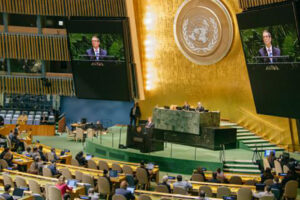
 On Wednesday, at the United Nations General Assembly, Cuban Minister of Foreign Affairs Bruno Rodríguez Parrilla denounced the economic, commercial, and financial blockade imposed by the United States against Cuba, as well as the pressure exerted on the body to compel member states to change their votes on the issue.
Wednesday morning, in an address, Bruno Rodríguez Parrilla spoke about the wave of pressure, intimidation, and blackmail employed by the U.S. delegation at the UNGA.
Statement by the Minister of Foreign Affairs of Cuba, Bruno Rodríguez Parrilla, during the debate on agenda item 37 of the UNGA: “Necessity of ending the economic, commercial, and financial blockade imposed by the United States of America against Cuba.”
New York, October 28, 2026
Mr. President, Your Excellencies, Permanent Representatives, distinguished delegates:
I wish to express my condolences to the Kingdom of Spain for the loss of life in the train accident in Toledo. I also wish to commend the President of the General Assembly for the way in which he ensured that the Assembly’s Rules of Procedure were upheld yesterday. I must denounce the disrespectful and provocative conduct of the United States delegation in this room yesterday — specifically, the harassment and non-consensual filming directed at our delegation by one of their officials, which necessitated the intervention of United Nations security personnel. Such actions are incompatible with the decorum, respect for personal dignity, and privacy that should prevail in this setting; furthermore, they constitute a maneuver aimed at undermining an important Cuban candidacy for a United Nations body.
I denounce the presence in this hall of a known terrorist — an individual responsible for acts of terrorism against Cuba and a representative of two terrorist organizations based on United States territory — who has been invited by the United States Permanent Mission to the United Nations. He is number 52 on the list of individuals internationally sought by the Republic of Cuba– pursuant to a legal resolution and the Official Gazette — for acts of terrorism.
He is also a criminal responsible for fraud; he has received substantial funding from the United States government, which he then diverted for personal use. I ask you, Mr. President, to request that the United Nations Secretariat verify the status under which this individual is present in the gallery, and I demand his immediate removal. His presence is an affront, Mr. President, to all victims of terrorism — in particular, the victims of September 11th and the Cuban victims of terrorist acts organized and financed from United States territory. It is an outrage and clear proof that it is not Cuba that should appear on the infamous list of state sponsors of terrorism.
Distinguished ambassadors, distinguished delegates:
The statement made yesterday by the representative of the United States of America has made the task of this Assembly — and my own responsibility to articulate the positions of the Republic of Cuba—somewhat easier.
He famously used the phrase, “This is America.” This was no mere slip of the tongue, nor a simple conceptual error. This is the United Nations — the Organization of the United Nations — the capital of multilateralism, and the heart of an international order that ought to be founded upon international law and the United Nations Charter. It is the most universal and democratic body within the United Nations.
That phrase reflects a worldview that treats the entire planet as if it were part of United States territory — a perspective that views Cuba, and indeed all of you, as if you were little more than an extension of one of the 50 states of the Union. It is the foundation of the concept of peace through strength — of imposing peace through strength.
Cuba is not a threat; the blockade is. It reveals sheer cynicism and hypocrisy to label Cuba an “unusual and extraordinary threat” to the national security of the planet’s greatest nuclear power.
The United States representative made a second, highly significant statement yesterday that brings greater clarity to the situation. He said: “The blockade against Cuba does not exist.”
Every minute of procedural delay — every minute of our deliberations — inflicts extraordinary harm upon our people. This cannot be measured by the clock in this chamber; rather — and I ask the webcast team to zoom in — it can be measured by this counter, which tracks the damage caused by the blockade against Cuba since the start of yesterday’s session, calculated in current US dollars. Since this session began, the damage resulting from the blockade has amounted to more than 22.9 million U.S. dollars.
Mr. President:
A major power is waging an economic war against a member state of this Organization — a small, independent, and peaceful nation that stands in solidarity with others. It does so with the aim of achieving domination and “regime change.” This aggression includes a fuel blockade—tantamount to a naval blockade—which constitutes an act of war, a form of collective punishment, and an act of genocide, all of which are prohibited under international law. Its severe consequences fall upon individuals, restricting their fundamental rights, affecting third-party nations, and transforming the essential needs of the population into instruments of political coercion.
Its effects are felt at the tables of Cuban families, at the bedside of the sick, during childbirth or in the operating room, in the food provided to children or in their classrooms; they manifest as a lack of electricity, potable water, and medicine, and as the high cost of goods essential for life.
The General Assembly has addressed this issue since 1992, but today it does so within a new and extraordinary context.
The United States government has unleashed a wave of pressure, intimidation, and blackmail against many member states, issuing a coercive, illegal, immoral, and unjustified demand that they abandon their long-standing positions—positions they have consistently and soundly maintained for decades as an exercise of their sovereignty—and instead adopt a stance to the contrary. I can demonstrate this with a document I have here. It is likely already in the possession of many of you.
The issue at hand is defining the General Assembly’s stance regarding the use of intimidation and unilateral coercive measures—tactics employed to dictate to other Member States what they should say and how they should vote; which nations they may trade with freely and which they may not; where their shipping companies may operate and where they may not; and with which countries they may maintain financial relations and with which they may not.
Today, this pressure is directed against Cuba; against which State might it be used tomorrow?
The issue at hand today is whether the United Nations condemns or accepts collective punishment — the attempt to break the political will of a sovereign state through economic strangulation, the infliction of hunger, suffering, and despair upon an entire population or the outright destruction of a nation.
It is well known that the United States government has drastically intensified its aggression against Cuba since the beginning of this year, with the publicly and officially declared intent to seize the country, control its economy and establish dominance. It has openly brandished the threat of military force and imposed dozens of additional coercive economic measures — on top of those that have existed for decades, which were already severely tightened in 2019 and have, since last January, escalated into a medieval-style siege.
Since July, this aggression has taken on a new and stark dimension, as the U.S. government seeks to obstruct, hinder, and sabotage the comprehensive program of economic and social transformation that our country has sovereignly charted for its economic and business structures—a necessary adaptation to the disastrous shifts in the international economic order and the economic war imposed upon us. Despite all this, we will not waver in our commitment to the well-being and dignity of the Cuban people.
On August 7, the Secretary of State, referring to Cuba’s efforts, stated publicly — and I quote: “What we’re trying to get them to understand is that there is no escape valve… every time they create a new mechanism to try to slip the noose, we’re just going to tighten it.” End quote.