
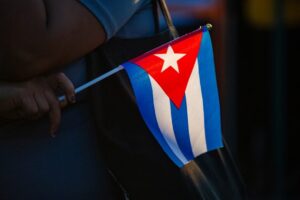
 Showing solidarity with Cuba is not a superficial gesture or a sentimental concession in the rhetoric of charity; it is, in its deepest sense, a historical affirmation of the future. It is not an isolated moral act, but a conscious practice that challenges the very structure of social relations against contemporary capitalism.
Where the dominant order seeks to subject all human connection to market calculations, solidarity with Cuba emerges as an active negation of that logic, as a praxis that reveals the concrete possibility of organizing life on different foundations: cooperation instead of competition, dignity instead of profit, community instead of atomization.
Because the Cuban experience, far from being an exotic object for distant contemplation, constitutes a field of tensions where the class struggle is expressed with particular clarity on an international scale. Its persistence cannot be understood without considering the systematic hostility it faces: economic blockade, media attacks, financial sabotage, diplomatic isolation. These forms of violence are not anomalies, but structural instruments of an economic dictatorship that punishes every socialist attempt. In this context, solidarity is not an ethical supplement, but a strategic necessity.
Defending Cuba is, ultimately, defending the very possibility for peoples to decide their destiny without submitting to the dictatorship of capitalism in its imperial phase.
Reducing solidarity to philanthropy means depoliticizing it, stripping it of its historical content, and turning it into a gesture compatible with the existing order. Philanthropy, in its bourgeois version, does not question the causes of inequality; it merely manages its effects, thus reproducing the structure it claims to alleviate. Revolutionary solidarity, on the other hand, is situated in the realm of causality; it does not seek to mitigate injustice, but to abolish the conditions that produce it. Therefore, showing solidarity with Cuba does not consist of “helping” from a position of superiority, but rather in recognizing oneself within the same web of exploitation and resistance. It is an act of material identification with a struggle that transcends national borders.
And class consciousness finds in this bond a moment of qualitative expansion. In a world where the dominant ideology promotes fragmentation, competition, and individualism, internationalist solidarity rebuilds the unity of the exploited as a historical subject. This is not a moral abstraction, but a concrete mediation: the understanding that the living conditions of workers anywhere in the world are determined by the same logic of accumulation operating on a global scale. Thus, the defense of Cuba is not an “external” matter, but a dimension of the internal struggle against local forms of domination.
This imperialist ideological offensive against Cuba seeks precisely to prevent this understanding. Through media saturation, information distortion, and the fabrication of slander, it attempts to establish the idea that the Cuban model is an intrinsic failure, an anomaly condemned by its very nature. This narrative deliberately obscures the material conditions in which the Cuban experience unfolds, ignoring the decisive weight of the blockade and external aggression. But, even more importantly, it seeks to deactivate the symbolic power of Cuba as a revolutionary reference point. The battle, therefore, is not only economic or political, but semiotic; the very meaning of possibility is at stake.
In this arena, solidarity acquires a crucial communicative dimension. It is not enough to denounce the aggressions; it is necessary to construct a field of revolutionary meaning that allows us to understand the Cuban experience in its complexity and historical density. This implies breaking with the categories imposed by the dominant ideology and developing a language capable of naming reality from the perspective of the people. Solidarity thus becomes a practice of meaning-making, a conscious intervention in the struggle for cultural hegemony. Cuba represents, in its concrete form, a social organization that challenges the private ownership of the means of production and the subordination of life to capital. This attempt is not perfect nor free of contradictions, but its very existence constitutes a threat to the dominant order, and it is attacked intensely.
And that is why its defense takes on a strategic character for overcoming capitalism. Solidarity, in this sense, is not one option among others, but a condition of possibility for building historical alternatives. Revolutionary fraternity, as the horizon of the new, cannot be reduced to an empty slogan. It is a practice that demands organization, commitment, and theoretical clarity. It implies recognizing that emancipation will not be the result of isolated actions, but of a collective process that articulates diverse struggles in a common project. In this framework, the relationship with Cuba should not be understood as uncritical adherence, but as an active dialogue, an interaction that allows us to learn from its achievements and its difficulties, integrating that experience into a broader perspective of social transformation.
Because the future that is affirmed in solidarity with Cuba is not an abstract promise, but a possibility inscribed in the contradictions of the present. Where capitalism shows its limits—recurring crises, growing inequality, environmental devastation—the need arises to think about and build alternative ways of life. Cuba, with all its tensions, embodies one of these possible forms. Defending it is, therefore, defending the openness of history against the closure imposed by capital. Revolutionary solidarity with Cuba is a form of historical self-defense.
It is not only about protecting a country, but about preserving the possibility of imagining and building a different world. In a time when the dominant ideology insists that there are no alternatives, every gesture of solidarity affirms the opposite: that history is not closed, that the future is not predetermined, that emancipation remains an open task. And this affirmation, far from being an act of faith, is a concrete practice inscribed in the daily struggle of the people.
Thus, solidarity ceases to be a moral adornment and becomes a tool for transformation. It is not charity, it is conscience; it is not assistance, it is alliance; it is not the past, it is the future. It encapsulates the certainty that emancipation will not be a gift, but a collective conquest, and that this conquest begins where peoples recognize each other as protagonists of the same contested history.