
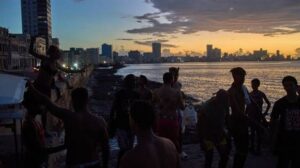
 The primary priorities for Democrats in the incoming Congress will likely be domestic accountability and affordability; however, the 120th Congress also has the opportunity to address one of the Trump administration’s most disastrous foreign policy legacies: a preventable humanitarian emergency fueled by an illegal fuel blockade against Cuba.
The U.S. blockade has stifled the Cuban economy for more than half a century. President Obama took historic and popular steps toward easing sanctions and normalizing relations with the island, with bipartisan support. The first Trump administration, however, rapidly reversed these gains, fueling an economic crisis marked by runaway inflation, food shortages, and outbreaks of preventable diseases. This deterioration continued under the Biden administration, which resisted calls for change until its final days.
By the start of Trump’s second term—with hardliner Marco Rubio at the helm of foreign policy—Cuba’s infant mortality rate had surged by 148%, and more than 10% of the population had left the island between 2022 and 2023.
Then came a near-total fuel blockade, enforced through tariffs, sanctions, and even the use of military force. Alongside the tightening of economic restrictions, Trump and Rubio have openly pursued regime change, expanded the U.S. military presence in the Caribbean, and repeatedly threatened invasion.
The economic crisis went into a freefall. Today, Cuba faces the worst humanitarian disaster in its modern history. Power outages are frequent, lasting for hours—if not days. When there is no electricity, there is also no refrigeration, running water, or fans to provide relief from the tropical heat. Food and medicine are in short supply. Hospitals report a backlog of medical procedures, with some surgeries performed by the light of mobile phones. Some patients have died as a result of this situation.
Crises rarely have a single cause, but there is little doubt as to who is responsible for a fuel blockade. Whatever the Cuban government may have done, its civilians do not deserve collective punishment.
Independent UN human rights experts have repeatedly denounced the fuel blockade as a violation of international law. The broader embargo has been routinely and overwhelmingly condemned in 34 annual United Nations votes.
This fuel blockade is cruel. It is illegal. It is an act of war. It is unpopular, both on the global stage and among American voters. It may even pose a risk to national security.
Given the new balance of power, Congress has the tools to address it.
The first step Congress can take is to vote on a War Powers Resolution that prohibits the unauthorized use of military force against Cuba—including for the purpose of enforcing the fuel blockade.
This should not wait for the new Congress to be seated. Representative Nydia Velázquez (D-N.Y.) has already introduced such a legislative measure; because War Powers resolutions are “privileged,” Democrats can bring Velázquez’s bill to a vote even while in the minority. The Democratic leadership refrained from doing so before the midterm elections—likely out of fear that it might harm Democratic candidates in Florida, where there is a powerful pro-sanctions constituency. With the elections now over, there is no reason to delay the vote. A similar vote in the Senate failed by a narrow margin in April, with the support of two Republicans. Even if a war powers resolution were to fall short of the votes needed for passage today, holding the vote would send a strong signal of the Democrats’ renewed willingness to address this issue and would provide momentum for the new Congress to continue that effort.
In 2027, the new Congress could pass this and other concrete measures to help end the hardships endured by the Cuban population:
* Ending the national emergency declaration from January, which serves as the basis for many of the recent sanctions.
* Removing the baseless designation of Cuba as a “state sponsor of terrorism,” which effectively excludes the country from the international financial system.
* Suspending the provisions of Title III of the Helms-Burton Act, which allow third parties to sue individuals and companies that “traffic” in property confiscated by the Cuban government.
Even those measures that fail to overcome a presidential veto would serve to clarify Congress’s position and impose a political cost on the Trump administration. More importantly, these initiatives could later